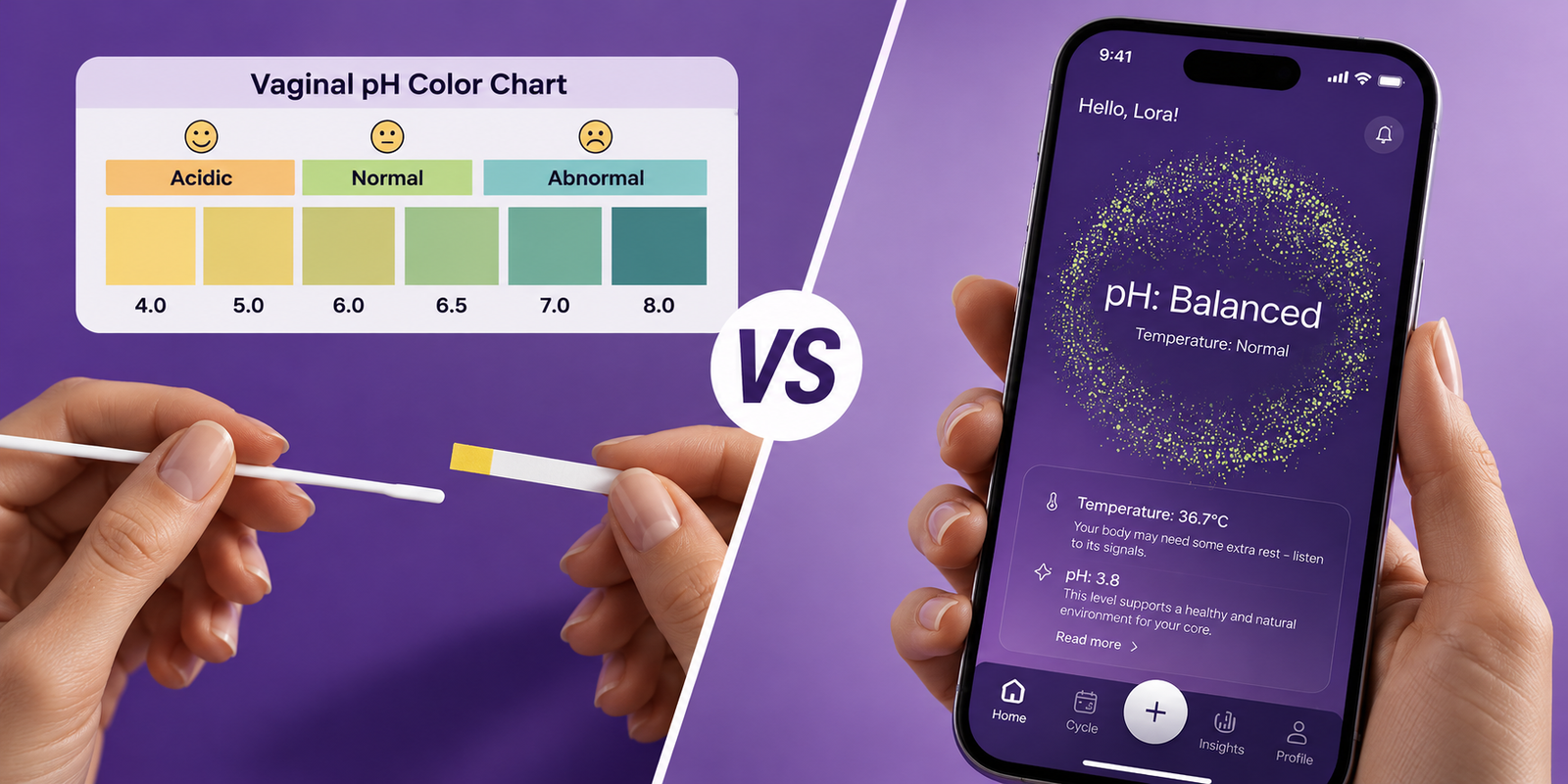

When we talk about health, we love the word normal.
Normal temperature. Normal blood pressure. Normal hormone levels. Normal vaginal pH.
Having reference ranges is extremely important in medicine. They help clinicians interpret measurements and identify when something may need further investigation.
But there is another question worth asking:
Does being within a population’s “normal range” tell us everything about what is normal for one individual woman?
When it comes to vaginal health, emerging research into the vaginal microbiome suggests the answer may be more complicated than a simple yes or no.
Your vaginal environment isn’t static. Microbial communities can change over time, and longitudinal studies show that the pattern and degree of those changes can differ substantially between women.
That brings us to an interesting concept: your vaginal baseline.
Not a magic number. Not a new diagnostic test.
Rather, a way of thinking about vaginal health in context.
Key takeaways
A vaginal microbiome associated with health does not necessarily look identical in every woman or remain completely unchanged over time. Research shows meaningful inter-individual variation in vaginal microbiome composition and dynamics.
Vaginal pH can provide clinically useful information, but it cannot diagnose a vaginal condition by itself. For example, an elevated pH above 4.5 can occur with bacterial vaginosis (BV) or trichomoniasis, but the CDC specifically notes that pH testing is not highly specific.
So perhaps the more useful future question isn’t simply “Is my number normal?”
It might also be:
“What is typical for me, and how is it changing?”
What do we actually mean by a vaginal baseline?
Imagine having one photograph of yourself.
It can tell us quite a lot about how you looked at that particular moment.
But if we wanted to understand how you’ve changed over several years, one photograph wouldn’t be enough. We’d need multiple photographs taken over time.
A biological baseline works in a somewhat similar way.
Rather than treating one measurement as the complete picture, repeated observations can help researchers investigate an individual’s usual range, variability and direction of change.
This distinction is particularly relevant to the vagina because it contains a dynamic microbial ecosystem.
Large scale research has found that age and other host and environmental variables are associated with vaginal microbiome composition. Longitudinal studies have also demonstrated substantial differences in trajectories: some women maintain relatively stable microbial communities, while others experience more frequent transitions.
That makes the concept of “normal” more nuanced than one universal biological state.
Your vaginal microbiome isn’t exactly the same as everyone else’s
The vaginal microbiome is the community of microorganisms living within the vaginal environment.
You’ve probably heard about Lactobacillus. Certain Lactobacillus species are frequently associated with vaginal microbial communities and the maintenance of an acidic environment.
But vaginal microbiomes aren’t identical from person to person.
And even within one individual, they aren’t necessarily frozen in time.
One longitudinal analysis incorporating thousands of samples found substantially different trajectories among women. Some remained within relatively stable community states, while others transitioned between different microbial compositions sometimes in association with menstruation.
That’s an important point.
Difference doesn’t automatically equal disease.
But it also doesn’t mean that every change should be considered harmless.
Understanding the difference requires context.
What about vaginal pH?
In reproductive-age women, vaginal pH is typically acidic, although it can vary with physiological and clinical circumstances. Clinically, vaginal pH can provide useful information when someone presents with symptoms. For example, a pH above 4.5 is commonly associated with BV or trichomoniasis.
But pH alone cannot tell us why the value is elevated.
The CDC explicitly states that vaginal pH testing is not highly specific, which is why clinicians evaluate it alongside symptoms, examination and appropriate laboratory testing.
This gives us an important principle:
A measurement can be informative without being diagnostic.
And that distinction becomes particularly relevant as consumers gain access to more personal health data.
“Normal range” and “normal for you” aren’t necessarily the same question
Population reference ranges answer an important clinical question:
How does this measurement compare with what is generally expected?
A personal baseline asks something different:
How does this measurement compare with this person’s previous pattern?
Neither question replaces the other.
Imagine that someone’s biological measurement normally stays within a relatively narrow pattern. A persistent shift from that pattern could potentially provide information for research, even before its clinical significance is established.
Someone else’s measurements might naturally show greater variability.
This is one reason longitudinal research is valuable: researchers can study trajectories, rather than treating every sample as if it came from an unrelated moment.
A large analysis of vaginal microbiome dynamics demonstrated exactly this diversity, with some participants showing relatively stable trajectories and others showing recurrent or rapid transitions.
So perhaps ‘normal’ has two dimensions: what is expected across a population, and what is typical for an individual.
Why patterns may tell us something a snapshot can’t
Most traditional health measurements are snapshots.
You attend an appointment.
A sample is collected.
A test is performed.
You receive a result.
Those snapshots are clinically essential. But your body continues functioning between appointments.
Your hormonal environment changes. You menstruate. You age. Your behaviours and exposures change. And your vaginal microbial ecosystem can change too.
Researchers can capture some of that complexity by collecting measurements repeatedly.
Instead of seeing:
Measurement → result
they can begin to investigate:
Measurement → change → pattern → trajectory
This doesn’t automatically make repeated measurements clinically meaningful, and it certainly doesn’t mean a pattern can diagnose a condition without appropriate validation.
But scientifically, longitudinal data allow researchers to ask questions that one isolated measurement simply cannot answer.
Could personal baselines become important in women’s health?
Potentially. But this is where we need to separate an exciting research direction from established clinical practice.Personalised and longitudinal health data are increasingly being studied across medicine. Vaginal microbiome research is also moving toward understanding individual trajectories rather than relying exclusively on cross-sectional snapshots.
Recent research reinforces how individual context can matter. A 2026 randomized-trial analysis of a Lactobacillus crispatus live biotherapeutic found that successful colonization was associated with several baseline characteristics, including the pre-treatment microbiota and baseline inflammatory profile.
That doesn’t mean we can currently define a clinically validated “personal vaginal baseline” and use it to diagnose disease.
We can’t.
But it does demonstrate why researchers are interested in what was happening before a biological change, not only what was measured afterward.
Your baseline could also change
There’s another important complication.
A baseline doesn’t necessarily mean one lifelong state.
Vaginal biology changes across the reproductive lifespan. A large 2025 population-level analysis found age-related differences in vaginal microbiome diversity and composition, with a notable compositional shift around age 45. Pregnancy is another example in which longitudinal studies have documented changes in vaginal microbial communities over time.
So even the concept of “normal for me” needs context.
Normal when?
At what age?
At what reproductive stage?
Under what hormonal conditions?
That’s precisely why women’s health deserves more than a single number mindset.
What a personal baseline cannot tell you
This part is especially important.
Knowing your usual body does not mean you should self diagnose an infection from a change in pH, discharge, smell or another observation.
Multiple conditions can cause similar vaginal symptoms. The CDC recommends appropriate clinical evaluation and laboratory testing because symptoms, history, or an isolated measurement alone may not reliably establish the cause. If you develop persistent unusual discharge, strong or unfamiliar odor, itching, burning, pain or other concerning symptoms, speak with an appropriate healthcare professional.
A baseline should never become a reason to ignore symptoms.
And a single deviation from what you think is your baseline shouldn’t automatically become a reason to panic either.
Maybe the better question isn’t “Am I normal?”
Women’s health conversations have spent a lot of time asking women to compare themselves with averages.
Sometimes that’s necessary.
But biology also happens at the individual level.
Your vaginal microbiome may not look identical to another woman’s.
Your vaginal environment doesn’t remain perfectly still.
And what researchers observe at one moment may not capture what happens across weeks, months or different stages of life.
So perhaps we need to add another question alongside “Is this normal?”
“What is normal for me and what happens when that pattern genuinely changes?”
We don’t yet have all the clinical answers to that question.
But asking it represents an important shift.
From snapshots to patterns.
From isolated numbers to context.
And potentially, toward complementing population-level reference ranges with a better understanding of how an individual woman’s biology changes over time.