
A Different Kind of Check-In
Let me ask you something: when was the last time you had a real-time conversation with your body?
Not a doctor’s visit.
Not a yearly checkup.
I mean a continuous, quiet stream of information.
That kind of self-awareness that tells you what’s happening as it happens.
For a long time, that kind of visibility didn’t exist in women’s health. We relied on snapshots. A test here. A symptom there. A lab result that arrived days later, sometimes weeks.
But something is changing.
Femtech is moving into a space where the body is no longer checked occasionally.
It’s being listened to continuously, gently, and from within.
And a big part of that shift is coming from advanced biosensors.
Why the Vaginal Environment Holds So Many Answers?
If you think about where the most meaningful signals might come from, the answer is actually quite intuitive.
The vaginal environment is dynamic. It responds to hormones, microbiome changes, infections, and fertility windows. And it is often before anything becomes clinically obvious.
And yet, historically, we’ve barely monitored it.
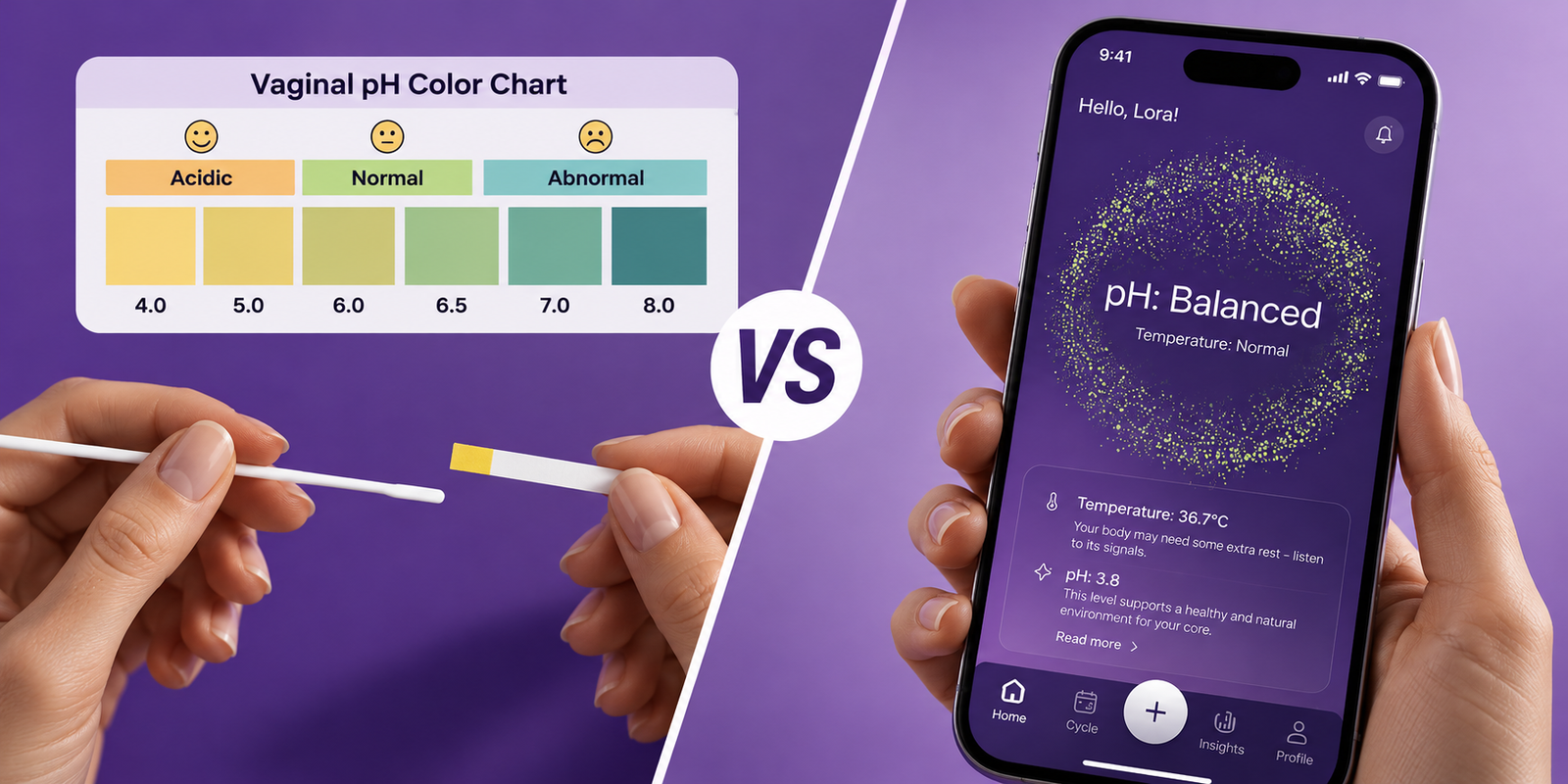
A simple example: vaginal pH.
Under normal conditions, it stays slightly acidic. Between 3.8 to 4.5. Largely thanks to beneficial bacteria like Lactobacillus. This acidity is protective. It keeps harmful microbes in check.
When that pH shifts upward, even slightly above 4.5, it can signal imbalance, often associated with conditions like bacterial vaginosis. Detection rates using pH changes alone can exceed 85%.
That’s not a subtle signal.
It’s a clear biological message.
And yet, for years, we’ve relied on occasional testing. Or worse (and very commonly), symptoms that appear after the imbalance has already progressed.
Now imagine capturing that shift in real time.
From Glass Probes to Living Sensors
The technology enabling this shift has been quietly evolving.
Early tools like glass electrodes worked, but they were impractical for continuous or in-body use: fragile, bulky, not designed for real life.
Today, we’re seeing something very different.
Sensors based on field-effect transistors (ISFETs) are being designed to translate biochemical changes directly into electrical signals. Hydrogen ions in vaginal fluid interact with the sensor surface, and those interactions are converted into readable data almost instantly.
No guesswork. No delay.
Even more interesting are newer materials like graphene. Because it’s only a single atom thick, it’s incredibly sensitive. When paired with biological recognition elements, these sensors can detect hormones, proteins, or pathogens at extremely low concentrations.
What that means in practice is simple.
We’re moving from indirect observation… to direct measurement.
Built for the Body, Not Just the Lab
Of course, sensing biology is one thing.
Doing it inside the human body, comfortably and reliably, is something else entirely.
And this is where design becomes just as important as science.
Vaginal environments are not easy on devices. They’re acidic, protein-rich, constantly shifting. Sensors have to withstand corrosion, avoid biofouling, and remain stable over time.
So engineers have adapted.
Designs keep sensitive electronics away from moisture while allowing a small interface to interact with the body. Flexible materials like polyimide and silicone allow devices to bend and move naturally, rather than resist the body’s shape.
Some sensors are now thinner than a human hair making them barely noticeable during use.
Even calibration, which used to be a challenge, is being addressed with built-in electronics and edge AI that can adjust for drift in real time.
The goal is not just accuracy.
It’s trust.
Temperature: The Signal We Almost Got Right
There’s one signal many people are already familiar with: temperature.
Basal body temperature has long been used as a proxy for ovulation. After ovulation, progesterone causes a small increase, about 0.3 to 0.7°C.
But here’s the limitation.
External measurements like wrist-based wearables and room-influenced readings can be inconsistent.
Internal sensors change that.
By measuring core temperature closer to the source, they provide a more stable and accurate signal. When combined with other data, like pH or hormonal markers, they create a clearer picture of the menstrual cycle.
Not as an estimate.
As a pattern grounded in physiology.
From Concept to Real Life
What makes this moment different is that these technologies are no longer confined to research labs.
We are starting to see real-world applications.
There are systems that provide continuous internal temperature tracking for fertility awareness, wearables that explore hormone detection through sweat, implantable systems that are being designed to monitor reproductive hormones continuously.
And research institutions are advancing miniaturized sensor systems that consume minimal power, making long-term use more practical.
We are moving from episodic care… to continuous insight.
From guessing… to measuring.
From reacting to symptoms… to seeing patterns before they escalate.
When you can see a pH shift as it begins, or a temperature pattern as it forms, or a microbial imbalance before it becomes symptomatic, the entire approach to care changes.
It becomes earlier.
More precise.
More personal.
At YON E Health, this is where the real opportunity lies. Because the body has always been communicating and we are developing a vaginal device that listens at the same level.