
A Shift You Can Feel
If you’ve been watching the femtech space for a while, you can feel that something is changing.
Not loudly. Not all at once. But steadily, almost like the field is exhaling after holding its breath for too long.
The first wave of femtech helped us track things like cycles, symptoms, patterns. It made women’s health visible in ways it hadn’t been before. And that mattered.
But now we’re stepping into something deeper.
People are calling it “deep femtech”. You can think of it as the moment where we stop just observing the body… and start measuring what’s actually happening inside it.
Because for all the progress we have made, the gap is still there. Women still spend about 25% more of their lives in poor health compared to men. That’s not a small difference. That’s years of life shaped by missed signals, delayed diagnoses, and systems that weren’t built with female biology at the center.
Deep femtech is trying to change that. Not just with surface-level fixes, but by going straight to biology and within the body.
Diagnostics That Finally Fit the Body in Front of Us
Let’s start with diagnosis, because this is where the gap has been most visible.
For years, tools were built around male physiology. So when conditions showed up differently in women, they were often missed or misunderstood.
Take endometriosis for example. On average, it takes close to ten years to diagnose.
T E N Y E A R S !
Or think about heart attacks. Women are still more likely to be misdiagnosed because their symptoms don’t match the “classic” presentation we were trained to recognize.
What’s changing now is not just awareness.
We are building new systems that increase its capability for diagnosis.
For example, blood-based markers, like C-reactive protein, are being used to assess long-term cardiovascular risk in ways that better reflect female physiology. AI is improving how we read dense breast tissue, where traditional imaging has struggled. New approaches are making prenatal ultrasounds faster and more accessible at the point of care.
And then there are the quieter breakthroughs… the ones that don’t always make headlines.
Menstrual fluid, for example, is being studied as a diagnostic source. Something that was historically dismissed is now being recognized as a rich biological signal, capable of revealing infections and potentially even early disease markers.
Companies are pushing into noninvasive cancer detection using nanotechnology. Moving screening earlier and making it less dependent on invasive procedures.
When you step back, you start to see the pattern.
Diagnostics are becoming less about approximation… and more about precision.
Sensors That Meet the Body Where It Is
Now, let’s talk about something that, at first, can feel a little unexpected.
Sensors inside the body.
More specifically, inside the vagina.
And I know. This is where people pause.
But if you think about it, it makes sense.
The vaginal environment is dynamic, responsive, and deeply informative. It reflects shifts in hormones, microbiome balance, inflammation, and infection.
So instead of sampling it occasionally in a clinical setting, deep femtech is asking a different question:
What if we could monitor it continuously?
Today, there are devices designed to do exactly that. Some measure pelvic muscle activity using electromyography, helping with conditions like incontinence through real-time biofeedback. Others track pressure changes to better understand prolapse during everyday movements.
Then there are chemical sensors.
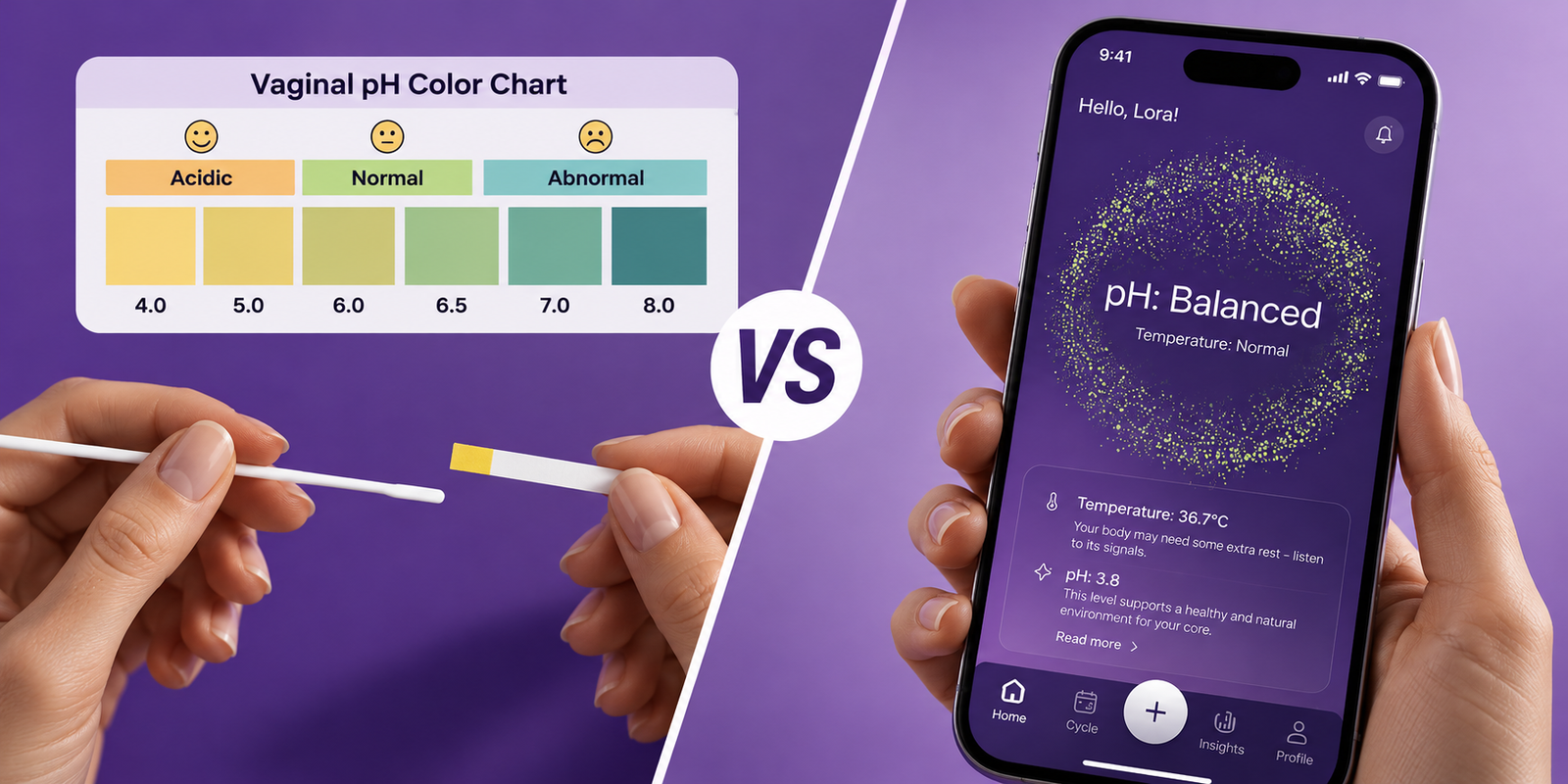
Devices that monitor pH levels, detect shifts linked to bacterial vaginosis, or even identify specific compounds like trimethylamine (the molecule associated with that characteristic “fishy” odor in Bacterial Vaginosis).
Smart tampons and vaginal rings are being developed to measure oxygen and carbon dioxide levels, picking up early signals of anaerobic bacterial growth.
There are even diagnostic tools that detect enzymes like sialidase directly from vaginal fluid, enabling rapid, point-of-care identification of infection.
All of this points in the same direction.
Care is moving closer to the source of the signal.
Wearables That Are No Longer Just Wearables
If you think back a few years, wearables were mostly about steps, sleep, heart rate.
Now they’re starting to feel different.
Devices have evolved to track core body temperature in ways that map directly onto hormonal cycles. When paired with other fertility platforms that are FDA-cleared for contraception, they move into clinical territory.
And then there are emerging technologies like continuous biochemical monitors, designed to track proteins and hormones without invasive sampling.
The shift here is subtle but important.
Wearables are no longer just recording behavior.
They’re beginning to interpret biology.
Care That Doesn’t Stop at the Clinic Door
One of the most meaningful changes is happening in how care is delivered.
Because the truth is, many complications don’t start in the clinic.
They start at home.
Postpartum care is a clear example. Conditions like hypertension or diabetes often develop or worsen after discharge, in a window where follow-up can be inconsistent.
Health systems use digital platforms to stay connected with patients remotely. Blood pressure cuffs and glucometers are paired with simple text-based check-ins. If something looks off, clinicians are alerted in real time.
The results speak for themselves.
Engagement rates above 90%. Significant reductions in readmissions. And perhaps most importantly: a closing of racial disparities in outcomes that had persisted for years.
This is what happens when data doesn’t stop at discharge.
The Microbiome Conversation We’re Finally Having
There’s another layer to this, and it’s one that’s been overlooked for a long time.
The vaginal microbiome.
We now understand that different microbial communities play very different roles in health.
For example, dominance by Lactobacillus crispatus is associated with protection, producing compounds that help prevent infection and reduce the risk of preterm birth. Other profiles are more unstable, more prone to imbalance.
What’s exciting is how this knowledge is being used.
Instead of repeatedly treating infections with antibiotics (and watching them return), new approaches are exploring microbiome restoration. Vaginal microbiota transplants, live biotherapeutics, engineered bacterial strains.
It’s a shift from suppression… to balance.
New Therapies, Designed Differently
As diagnostics improve, treatment is evolving alongside it.
Medical devices are being redesigned to better fit female anatomy, making procedures less invasive and more effective.
New drugs are emerging as well. Fezolinetant, for example, targets neurokinin pathways in the brain to reduce hot flashes without relying on hormone replacement therapy. Elinzanetant is showing promising results in late-stage trials.
In other areas, treatments like Linzagolix are expanding options for conditions like fibroids. Early research is exploring compounds like Artemisinin for PCOS.
And then there’s the frontier work: stem cells, organoids, regenerative approaches that aim not just to treat, but to rebuild.
It’s early. But it’s moving.
Where This Is All Heading
If the first wave of femtech helped us track what we could see, deep femtech is helping us understand what we couldn’t.
It is building systems where screening leads to diagnosis, diagnosis leads to treatment, and treatment is guided by real, female-specific data.
At YON E Health, this is where the work becomes meaningful. Because the body has always been sending signals. What’s changing is our ability and willingness to listen at the right level.
There are still challenges. Clinical trials remain uneven. Privacy concerns are real. Regulation is catching up.
But the direction is clear.
We are moving from approximation to precision.
From observation to understanding.
From fragmented care… to connected systems.
And once you see that shift, it’s hard to unsee it.
Because it doesn’t feel like a trend.
It feels like medicine, finally, becoming more complete and aligned with your body.