
A System Built on an Incomplete Baseline
There’s a starting point we don’t always acknowledge when we talk about modern medicine.
For a long time, the male body was treated as the default.
It wasn’t framed that way explicitly, but it showed up in how research was designed, how clinical trials were conducted, and how treatments were developed.
Women were often excluded from early-phase studies. In fact, in 1977, the FDA issued guidance that restricted women of childbearing potential from participating in those trials. Even after policies shifted, inclusion remained uneven.
And the effects didn’t stay in research.
They followed patients into exam rooms.
Doctors made decisions using data that didn’t fully represent the people in front of them. Drug dosing, symptom recognition, treatment pathways. All shaped by a baseline that was incomplete. Some medications were later withdrawn due to safety risks in women at significantly higher rates than in men. Women, on average, spend about 25% more of their lives in poor health.
When you step back, you start to see the pattern.
It’s not that the system failed intentionally.
It’s that it was built on partial data.
Giving the Gap a Direction
The idea behind using femtech to close the gap is simple, but powerful. It sits at the intersection of healthcare and technology and focuses on one core shift: enabling women to generate, track, and use data about their own bodies at scale.
That shift matters because data changes how systems behave.
When something is measured consistently, it becomes visible. When it becomes visible, it can be studied. And once it is studied, it can begin to reshape care.
Femtech, in that sense, is not just about innovation.
It is about building the dataset that medicine never fully had.
Turning Lived Experience Into Evidence
One of the most important contributions of femtech is something that feels almost obvious once you see it.
It turns lived experience into structured data.
For decades, symptoms like cycle irregularity, fatigue patterns, hormonal fluctuations, or pain intensity were often described qualitatively… if they were captured at all! They were considered subjective, inconsistent, and difficult to quantify.
Now, apps and wearables are collecting that information continuously.
Cycle data. Basal body temperature. Sleep patterns. Symptom tracking. Fertility signals.
Individually, these data points might seem small. But at scale, they become powerful.
Through anonymized datasets, many femtech companies have supported research collaborations with top tier research institutions and universities.
What emerges is not just convenience for users.
It is evidence.
Moving Beyond Tracking: The Rise of Deep Femtech
The first wave of femtech helped us see patterns.
The next wave is trying to understand them at a deeper level.
This is often referred to as “deep femtech”. It is a space where artificial intelligence, bioengineering, and hardware come together to generate entirely new types of biological data.
Here, the focus shifts from tracking symptoms to measuring underlying mechanisms.
For example, AI tools are being developed to improve the accuracy of dense breast imaging. Additionally, new diagnostic systems aim to detect ovarian and endometrial cancers earlier. Molecular wearables are emerging that can monitor hormones, proteins, and other biomarkers in real time, without requiring invasive procedures.
And then there are innovations that move even closer to the body.
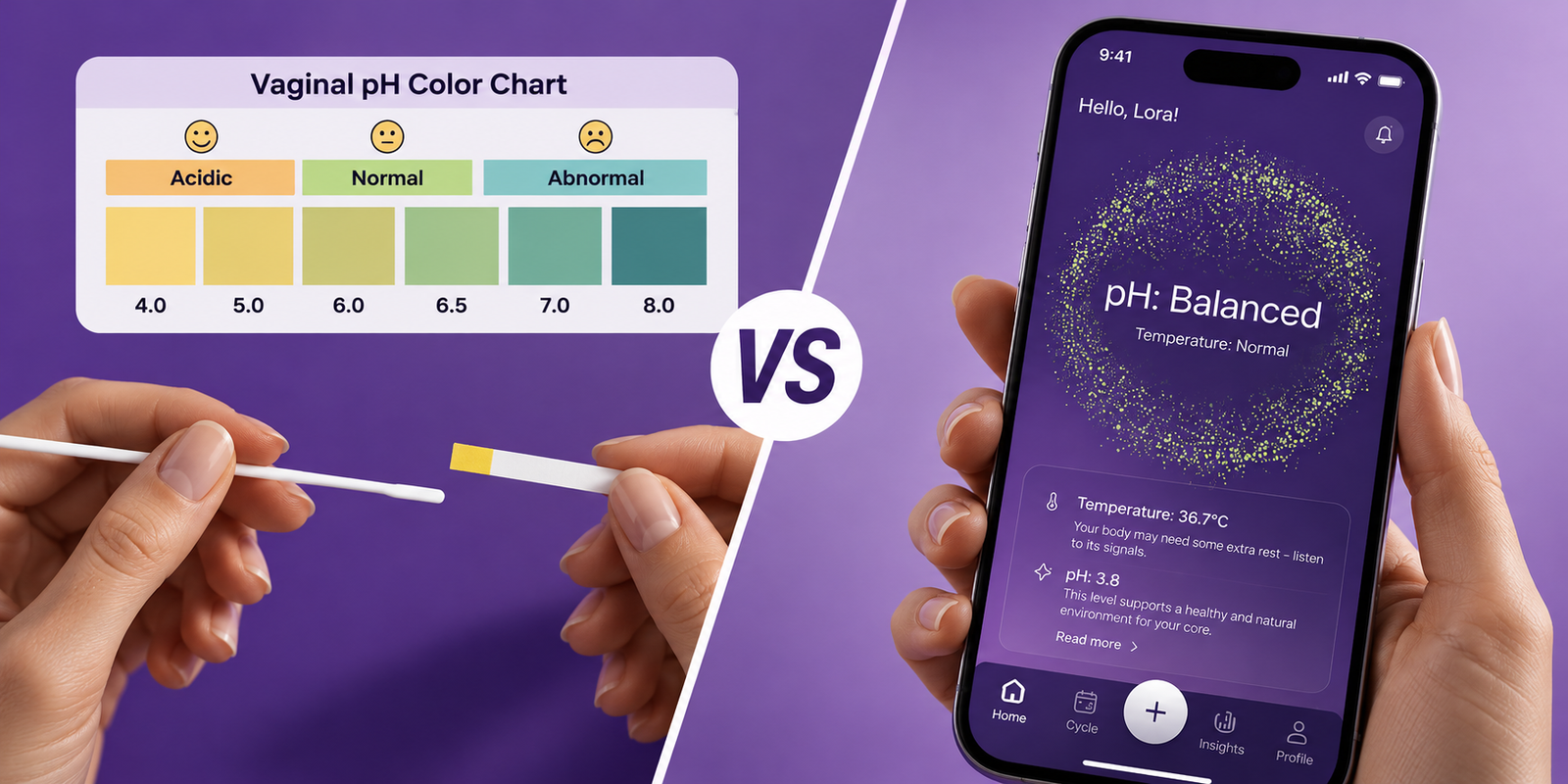
Vaginal sensors are being designed to monitor biomarkers such as pH, carbon dioxide, inflammatory cytokines, and microbial signals associated with conditions like bacterial vaginosis.
At first, these technologies can feel unfamiliar.
But they represent logical progression.
When you measure biology directly with real time data, you reduce reliance on assumptions.
And many of those assumptions, historically, were built on incomplete data.
Bringing Care Into Real Time
The gender data gap is not just a research problem.
It shows up in everyday care, especially in moments that fall between clinical visits.
Maternal and postpartum care is a clear example. Many complications develop after patients leave the hospital, during a period where monitoring is limited and follow-up care can be difficult to access.
This is where femtech begins to change the structure of care itself.
Several platforms have enabled health systems to monitor patients remotely after birth. By combining home devices like blood-pressure cuffs and glucometers with text-based communication, care teams can stay connected to patients in real time.
The results are practical:
- Higher engagement in monitoring.
- Fewer readmissions.
- Earlier detection of complications like postpartum hypertension and diabetes.
- Reductions in long-standing disparities, such as differences in readmission rates across racial groups.
This is what closing a data gap looks like when it reaches the point of care.
Not abstract.
Operational.
The Privacy Tension We Cannot Ignore
As femtech expands, it introduces a new kind of responsibility.
Because the data it relies on is deeply personal.
Menstrual cycles. Fertility windows. Pregnancy status. Sexual activity. Mental health indicators.
Much of this data exists outside traditional healthcare protections like HIPAA in the United States. Some platforms rely on third-party tracking systems or share data with external companies. Privacy policies are often complex enough to limit meaningful consent.
And in a shifting legal landscape, reproductive data can carry implications beyond healthcare.
This creates a tension at the heart of femtech.
The same data that enables better care also requires stronger protection.
If femtech is to fulfill its potential, privacy cannot be an afterthought. It has to be built into the system from the beginning. It has to be built through minimal data collection, transparent practices, and safeguards that recognize the sensitivity of what is being measured.
The Economic Case for Closing the Gap
There is also a broader perspective worth considering.
Closing the gender data gap is not only a health issue. It is an economic one.
Women spend approximately 25% more of their lives in poor health compared to men. That translates into millions of years of lost productivity, increased healthcare costs, and reduced quality of life.
There are some estimates that suggest that improving women’s health could add at least $1 trillion annually to the global economy by 2040. And, for every dollar invested, the projected return is multiple times that in economic growth.
Better data leads to earlier diagnosis.
Earlier diagnosis leads to more effective treatment.
Effective treatment supports participation in the workforce, in communities, in daily life.
The impact compounds.
A System Being Rewritten
Femtech is often described as a category within digital health.
But that framing only captures part of what is happening.
What we are seeing is a gradual rewriting of the foundations of medical data.
For decades, gaps existed because certain signals were not captured, not measured, or not prioritized. Femtech is beginning to fill those gaps through apps, wearables, AI systems, and sensors that bring biology into clearer focus.
At YON E Health, this is where we begin: with the recognition that the body already holds the data we need.
When we start to measure consistently, patterns emerge.
When patterns emerge, systems can change.
The ethical questions are real. The risks are not trivial.
But neither is the opportunity.
Because at its core, femtech is not just about technology.
It is about building a more complete version of medicine. A version that reflects the full spectrum of human biology, rather than a partial view.
And that shift, once it starts, tends to carry forward.