
Have you ever noticed that your body feels different at night compared to the morning?
Maybe you feel more sensitive, slightly drier, or just more aware of discomfort later in the day even when nothing obvious has changed.
It can feel confusing. Especially when we’re used to thinking about changes in terms of the menstrual cycle, not within a single day.
But the truth is, your body doesn’t only follow a monthly rhythm.
It also follows a daily rhythm.
And your vaginal tissue is part of that.
Your Body Runs on a 24-Hour Rhythm
Every system in your body is influenced by something called the circadian rhythm your internal 24 hour clock.
This rhythm regulates:
- Hormone release
- Body temperature
- Immune activity
- Fluid balance
- Tissue sensitivity
So even if your environment stays the same, your body is constantly adjusting internally.
And these changes can influence how your vaginal tissue feels throughout the day.
Hormones Don’t Only Change Monthly
We often associate hormones with the menstrual cycle.
But some hormones fluctuate daily, not just monthly.
For example:
- Cortisol (your stress hormone) is highest in the morning and gradually decreases throughout the day
- As cortisol drops, your body becomes less “alert” and more sensitive to internal signals
This means that by the evening, you may:
- Feel sensations more strongly
- Be more aware of subtle discomfort
- Notice changes you didn’t earlier in the day
It’s not that something suddenly changed.
It’s that your body is perceiving things differently.
Hydration and Tissue Sensitivity Shift
Your body’s hydration status also changes throughout the day.
As the day progresses:
- Fluid balance shifts
- Tissue hydration can decrease slightly
- Blood flow patterns change
This can affect how vaginal tissue feels.
Some women may notice:
- Increased dryness later in the day
- More friction or sensitivity
- A general feeling of “discomfort” without a clear cause
These changes are often subtle but they are real.
The Role of the Nervous System
Your nervous system also plays a role.
As your body becomes more fatigued in the evening:
- Sensory perception can increase
- Your awareness of internal sensations becomes stronger
This is why something you didn’t notice in the morning might feel more pronounced at night.
It doesn’t necessarily mean the condition has worsened.
It may simply mean your body is more tuned in.
Why This Can Feel Confusing
Most of us are taught to look for consistent symptoms.
If something changes, we assume:
- Something is wrong
- Something has developed
- Something needs to be fixed
But the body is not static.
It is constantly responding to internal rhythms.
So when vaginal sensation changes across the day, it can feel unpredictable even though it’s actually part of a pattern.
Understanding Daily Changes vs. Clinical Symptoms
So how do you know what’s normal?
Daily variation is usually normal when:
- Changes are mild
- They fluctuate throughout the day
- They don’t progressively worsen
- They resolve on their own
However, it’s important to seek medical advice if:
- Symptoms are persistent and do not fluctuate
- There is significant pain, burning, or irritation
- Discharge is unusual in colour, consistency, or odour
- Discomfort interferes with daily life
The goal is not to ignore symptoms.
It is to understand their context
The Bigger Picture: Your Body Is Not Inconsistent
We often describe the body as inconsistent when sensations change.
But in reality, it is highly regulated.
Your body follows:
- A monthly rhythm (your cycle)
- A daily rhythm (your circadian system)
And both influence how your vaginal tissue feels.
So what seems like unpredictability is often just biology in motion.
Why This Matters in Practice
Understanding these daily shifts is not just about awareness, it’s about pattern recognition.
If your vaginal environment changes not only across your cycle, but also across the day, then a single snapshot doesn’t tell the full story.
This is where many women get stuck.
You might notice dryness, irritation, or changes in comfort but without context, it’s hard to know:
- Is this normal?
- Is this hormonal?
- Is this something I should worry about?
And most of the time, there is no way to track these changes continuously or objectively.
This is exactly the gap we’re trying to address.
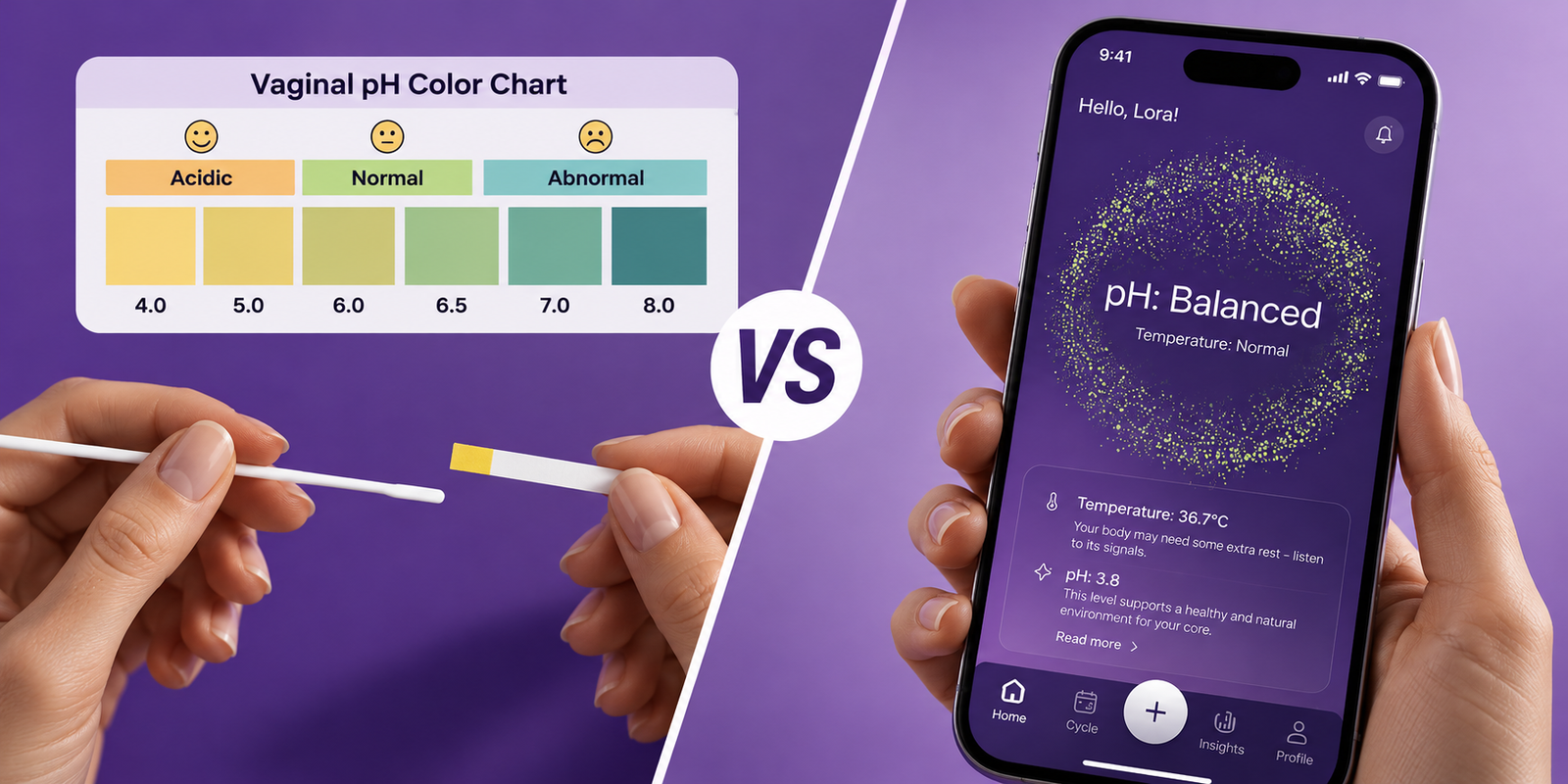
At YON E, we’re building a medical device designed to monitor key vaginal health indicators like pH and basal body temperature over time not just once, but continuously.
Because your body is not static.
It shifts across the month.
It shifts across the day.
And when you can actually see those patterns, everything changes.
Instead of guessing, you start understanding and feeling empowered with your data.