
Introduction: When Everything Felt Fine… Until It Didn’t
Have you ever felt completely normal and then noticed a change after sex?
Maybe:
- A different smell
- Slight irritation
- More sensitivity
- Or discharge that doesn’t feel like your “usual”
And the confusing part?
Everything about the experience felt normal.
No pain.
No obvious issue.
No clear reason to worry.
So what changed?
The answer is not always infection.
Sometimes, it’s biology.
Sex Is Not Just Physical It Changes Your Internal Environment
Sex introduces more than just physical contact.
It introduces:
- Fluids
- Friction
- Microbial exchange
- And temporary shifts in your vaginal pH
Your vaginal environment is naturally acidic this is what protects you.
But semen has a higher (more alkaline) pH.
So after sex, your vaginal pH can temporarily increase.
This doesn’t mean something is wrong.
But it does mean your environment has changed.
Your Microbiome Responds Immediately
Your vaginal microbiome is designed to stay balanced but it’s also highly responsive.
After sex, your body may:
- Adjust bacterial composition
- Shift pH levels
- Activate immune responses
For many women, this shift is subtle.
For others, it might feel like:
- Mild irritation
- Slight odor change
- Increased sensitivity
Even if everything is “healthy.”
This is your body adapting not necessarily failing.
Friction and Sensitivity: Why Things Can Feel Different
Even when sex is comfortable, friction still affects the vaginal lining.
Your tissue is:
- Soft
- Hormone dependent
- And sensitive to micro changes
So after sex, some women notice:
- Temporary dryness
- Mild burning sensation
- Increased sensitivity
This doesn’t automatically mean damage or infection.
Sometimes, it simply means the tissue is reacting.
Hormones Also Play a Role (More Than You Think)
Your experience after sex can vary depending on where you are in your cycle.
For example:
- Around ovulation → tissue is more lubricated and resilient
- Before your period → tissue can be more sensitive and reactive
So the same experience can feel completely different depending on timing.
This is why something that felt fine one week might feel different the next.
When Is It Normal and When Should You Pay Attention?
After understanding all this, the real question becomes:
What’s actually normal?
Post sex changes are often physiological when they:
- Are mild
- Resolve within a short time
- Don’t worsen
- Follow a pattern
However, you should seek medical evaluation if:
- Symptoms persist or worsen
- There is strong or unusual odor
- You experience significant pain or burning
- There is persistent itching or discomfort
The goal is not to ignore symptoms.
It’s to understand what your body is responding to.
The Bigger Picture: Your Vaginal Environment Is Dynamic
One of the biggest gaps in women’s health education is this:
We expect consistency in a system that is designed to change.
Your vaginal environment responds to:
- Hormones
- Microbial exposure
- Physical interaction
- Internal biology
That means change does not always equal a problem.
Sometimes, it’s simply a response.
What This Ultimately Means
Feeling different after sex doesn’t always mean something went wrong.
Sometimes, it means your body is adjusting.
Your vaginal microbiome is not fragile, it’s responsive.
And the more you understand these patterns,
the less confusion and fear you carry.
Because not every shift is a signal of disease.
Sometimes, it’s just your body doing its job.
Why This Matters in Practice
Your vaginal microbiome doesn’t change in isolated moments; it responds continuously to what your body experiences.
And that includes sex.
But most diagnostics still capture only a single point in time.
So you might notice a change…
without anything showing up.
That disconnect is real.
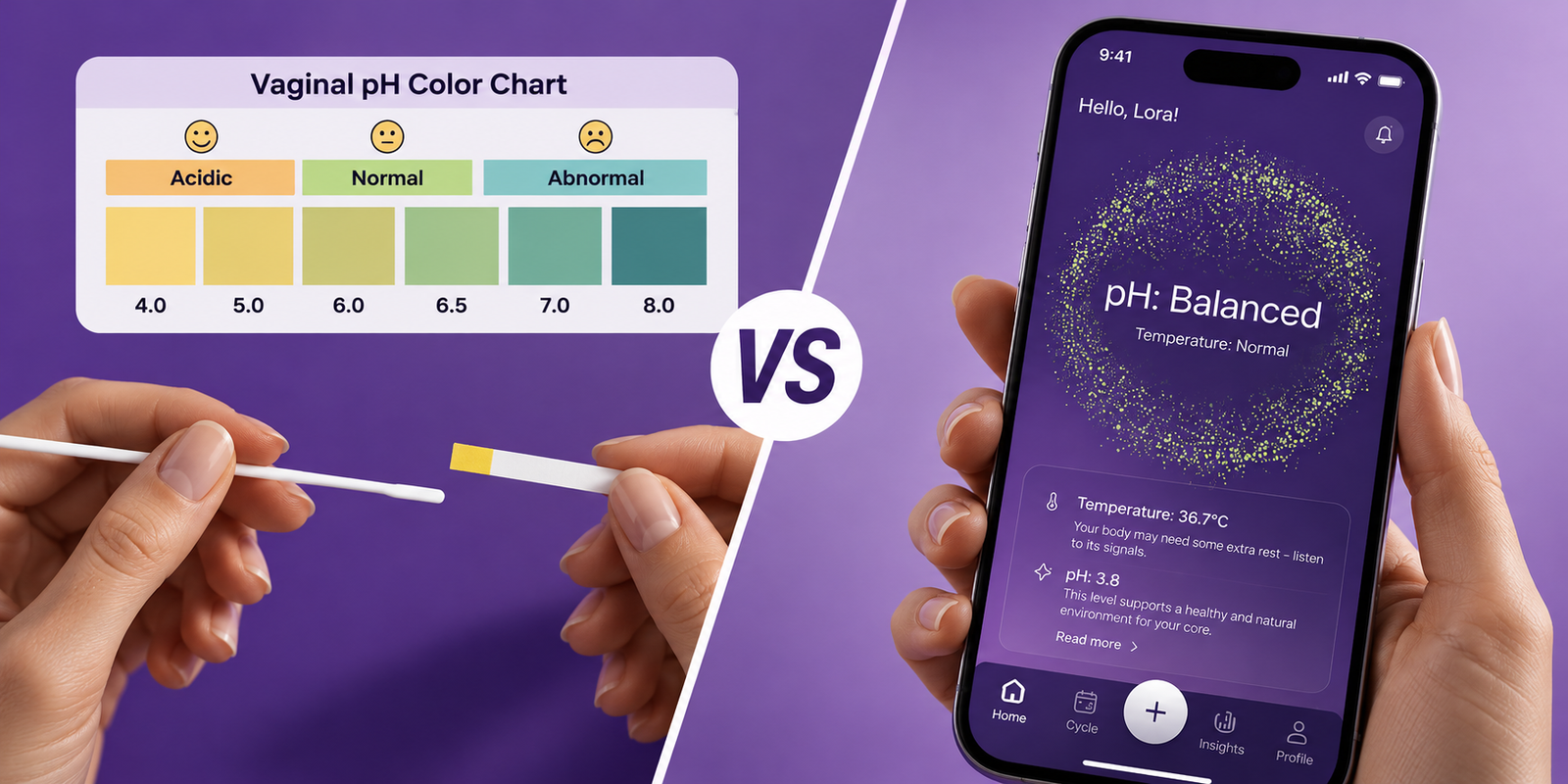
At YON E, we’re building a medical device designed to continuously track vaginal pH and basal body temperature so these shifts don’t go unnoticed.
Because understanding your vaginal health isn’t about one moment.
It’s about seeing the pattern.