
A Space That Finally Has a Name
Let me start with something simple.
For a long time, women’s health innovation existed… but it didn’t quite have a name. It lived in fragments like fertility apps, pregnancy tools, a few devices scattered across specialties. Useful, yes. But there is such a disconnection! It is hard to define. Even harder to fund.
Fortunately, that changed in 2016, when Ida Tin, co-founder of Clue, introduced the term femtech.
It sounds like a small change. After all, it is just a word. Or is it?
Giving something a name does something powerful. It makes it visible. It makes it legible to investors, researchers, policymakers. And maybe most importantly, it opens the door to conversations that had been quietly avoided for decades: menstruation, menopause, sexual health.
Topics that were always central to women’s lives, but rarely central to innovation.
More Than Period Tracking
Let’s rewind a decade. 10 years ago, most femtech products lived in one narrow lane: cycle tracking and fertility awareness.
Important? Yes. But so incomplete!
Today, the field has expanded far beyond that. Femtech now spans maternal care, pelvic health, menopause, endometriosis, PCOS, and even broader conditions like cardiovascular and autoimmune diseases that present differently in women.
And that evolution tells a deeper story.
It reflects a shift from tracking symptoms… to understanding systems.
From logging cycles… to measuring biology.
From helping women manage around the edges… to beginning to redesign care itself.
Why Femtech Had to Exist
To understand why femtech matters, we have to sit for a moment with an uncomfortable reality.
For decades, medicine treated the male body as the default.
Clinical trials often excluded women, especially in early phases. Even after the National Institutes of Health required better inclusion in 1993, investment in women’s health remained disproportionately low. Today, only about 4% of global healthcare R&D funding is directed toward women’s health initiatives.
That gap is not abstract. It shows up in real outcomes.
Women are more likely to experience delayed diagnoses. Their symptoms are more likely to be misunderstood. Drug side effects that were never fully studied in female physiology appear later, in real-world use.
One of the clearest examples is heart health. Women are significantly more likely to be misdiagnosed or even discharged during a heart attack because their symptoms do not match the historical “norm,” which was defined primarily using male data.
When the baseline is incomplete, everything built on top of it carries that gap forward.
Femtech, in many ways, is a response to that gap.
Not as a trend, but as a correction.
From Niche to a $50 Billion Dollar Industry
What started as a small corner of digital health is now becoming something much larger.
In 2019, global femtech revenue was estimated between $600 million and $820 million. Projections suggest it could reach $50 to $60 billion by 2027.
That kind of growth is not just market momentum. It is unmet need becoming visible.
The market itself is often divided into three major segments:
- Pre-Menopausal Care: it is the largest segment with more than 70% of revenue. It focuses on menstrual health, contraception, fertility, pregnancy, and postpartum tools. This is where femtech first took hold, and it remains foundational.
- Menopausal and Post-Menopausal care, long overlooked, represents an estimated $600 billion opportunity. That number alone tells you how much has been ignored and how much remains to be built.
- Chronic-Condition Care: endometriosis, fibroids, PCOS. These are conditions that affect millions of women worldwide. Endometriosis alone impacts around 190 million women globally. Yet, these conditions have historically been underdiagnosed and undertreated.
The market is expanding because the biology was always there.
We are just now catching up.
A Technological Turning Point
The first wave of femtech made women’s health easier to see.
The next wave is trying to understand it.
We are now moving into a phase where AI, clinical validation, and advanced biosensing are converging. Tools are being designed not just to track symptoms, but to interpret them. To connect patterns across time, across hormones, across systems.
Some technologies are already reshaping how we detect disease. AI-assisted imaging is improving the accuracy of dense breast screening. New approaches are emerging for earlier detection of ovarian and endometrial cancers.
And then there are the more ambitious innovations: the ones that move closer to the body.
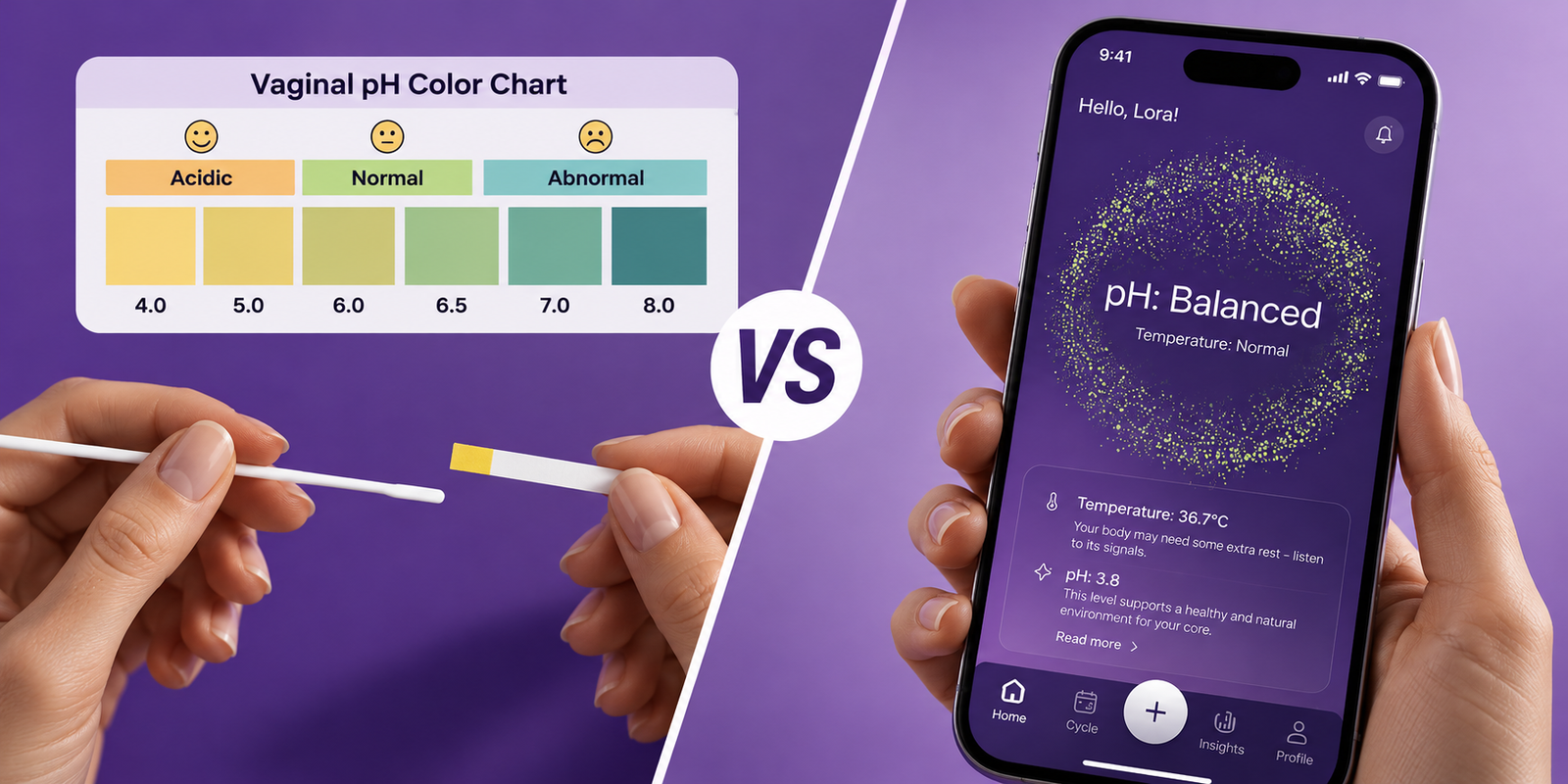
Molecular wearables that track hormones in real time. Vaginal sensors embedded in rings or smart tampons, capable of monitoring pH, bacterial signals, inflammatory markers. They are continuously and passively adding value without requiring a clinic visit.
If that sounds futuristic, it is. But it is also very logical.
Because the closer we get to the biology with real time data, the clearer the signal becomes.
Built by Women, Funded Differently
One of the most distinctive aspects of femtech is who is building it.
Estimates suggest that more than 70%, but possibly as many as 90%, of femtech companies have at least one female founder.
That matters.
Because lived experience shapes what gets built, what problems are prioritized, and how solutions are designed.
But when we look at funding, there is another story. The picture shifts.
Women-led ventures receive just over 2% of total venture capital. Femtech itself captures only about 1.4% to 3% of digital health investment.
There is a disconnect here.
The people closest to the problem are building the solutions. But unfortunately, they are not always the ones controlling the capital.
Part of that gap comes down to representation. Around 90% of venture capital decision-makers are men. And many founders report that women’s health is still misunderstood, minimized, or seen as too narrow to scale.
And yet, the market data tells a different story.
After major policy shifts like the overturning of Roe v. Wade, there has been a noticeable increase in social-impact investment flowing into women’s health. It is a signal that awareness is changing, even if unevenly.
The Privacy Question We Cannot Ignore
As femtech grows, it brings with it an important tension.
These technologies collect deeply personal data: menstrual cycles, ovulation patterns, pregnancy status, sexual activity, mental health indicators.
And yet many of these tools operate outside of traditional healthcare privacy protections like HIPAA in the United States.
That creates space for vulnerability.
Data can be shared with third parties. It can intersect with location tracking, advertising networks, even legal systems. In certain contexts, reproductive data is not just personal — it is sensitive in ways that extend beyond health.
At the same time, access remains uneven.
Subscription costs can limit who benefits from these tools. Many products are still designed with a narrow user profile in mind, leaving out LGBTQ+ women, transgender men, and non-binary individuals.
So while femtech expands possibility, it also raises questions.
Who is included?
Who is protected?
Who is left out?
More Than a Market, A Redesign
It is tempting to describe femtech as a fast-growing market, a new category, a promising investment space.
But that framing is incomplete.
Femtech is not just about building new products for women.
It is about rethinking the assumptions that shaped medicine in the first place.
It asks a fundamental question: what happens when we stop treating women’s bodies as variations… and start treating them as central?
At YON E Health, this is where we begin. By listening to the body and following the data it provides. The patterns we are now able to measure were always there. What has changed is our willingness to see them, to name them, and to build around them.